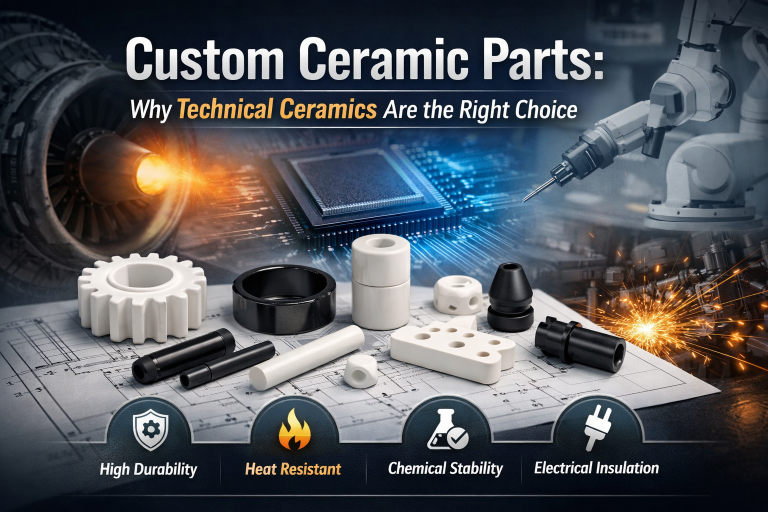
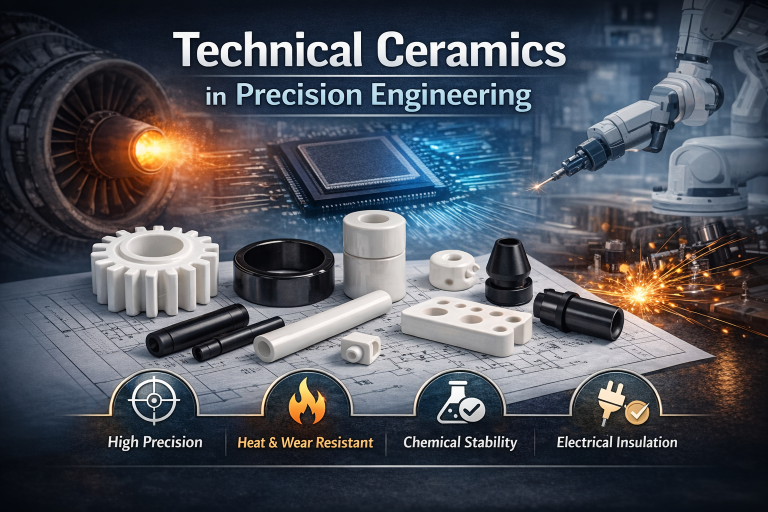
Technical ceramics now play a central role in modern industry. They support applications ranging from microtechnology and medical devices to energy systems, electronics and advanced manufacturing. Over time, their importance has continued to grow as industrial requirements have become more demanding.
Today, performance alone is no longer sufficient. Manufacturers increasingly expect materials that enable innovation while also supporting environmental responsibility. As a result, the future of technical ceramics lies at the intersection of technological progress and sustainability. New materials, improved processes and responsible production models are reshaping how ceramics are designed and used.
Innovation Driven by Advanced Ceramic Materials
Innovation in technical ceramics goes far beyond incremental improvements. Researchers now focus on developing materials with enhanced and multifunctional properties. These advances allow ceramics to address complex engineering challenges more effectively.
For example, ceramic composites combine high toughness with excellent wear and thermal resistance. Nanostructured ceramics further improve mechanical strength while reducing ageing effects. In addition, functional ceramics introduce electrical, ionic or thermal capabilities tailored to specific applications.
Thanks to these developments, technical ceramics no longer serve only as structural materials. Instead, they actively contribute to system efficiency, reliability and miniaturisation.
Manufacturing Technologies Shaping the Next Generation
Equally important, manufacturing technologies continue to evolve rapidly. Traditional forming and sintering methods remain essential, yet advanced processes now complement them to increase precision and efficiency.
Modern sintering techniques, such as field-assisted sintering, reduce energy consumption while improving microstructural control. At the same time, high-precision machining enables ceramic components to achieve micrometric tolerances previously associated mainly with metals.
Moreover, ceramic additive manufacturing represents a major technological shift. Ceramic 3D printing allows the production of complex geometries, internal channels and lightweight structures. Consequently, manufacturers can support rapid prototyping, small-batch production and customised designs with greater flexibility.
Micro-Production and Customisation as Key Trends
As industrial systems become smaller and more precise, demand for micro-scale ceramic components continues to rise. For this reason, micro-production is becoming a defining trend in the technical ceramics sector.
Industries such as medical technology, watchmaking and microelectronics increasingly require components with extremely tight tolerances, produced in limited volumes. Technical ceramics respond well to this need because they offer dimensional stability and long-term reliability.
At the same time, micro-production enables a higher level of customisation. Patient-specific medical implants, application-tailored sensors and specialised micro-components are now achievable thanks to advanced ceramic processing methods.
Sustainability as a Core Industrial Objective
Sustainability has become a strategic priority across all industrial sectors. In this context, technical ceramics already offer significant advantages. Their long service life, resistance to wear and corrosion, and minimal maintenance requirements reduce material consumption over time.
However, the future of technical ceramics also depends on improving production sustainability. Manufacturers therefore invest in energy-efficient furnaces, optimised sintering cycles and better raw material utilisation. In addition, reducing waste and recycling ceramic powders contribute to lower environmental impact.
As a result, technical ceramics support a more sustainable industrial model by combining durability with responsible manufacturing practices.
Expanding Applications in Critical Industries
The role of technical ceramics continues to expand in critical and emerging sectors. In medical applications, they enable durable implants, miniaturised devices and improved biocompatibility. Within energy systems, ceramics support fuel cells, thermal management solutions and advanced sensor technologies.
Similarly, in electronics and microtechnology, technical ceramics provide reliable insulation, heat dissipation and precision at increasingly smaller scales. Their ability to perform under harsh conditions makes them indispensable for next-generation technologies.
The Strategic Role of Specialized Manufacturers
Ultimately, the future of technical ceramics depends on manufacturers capable of combining innovation with sustainability. Expertise in materials science, process control and quality assurance becomes a decisive advantage.
Specialised manufacturers that integrate research and development, micro-production capabilities and sustainable practices are best positioned to meet evolving industrial demands. Furthermore, early collaboration with customers during the design phase enables more efficient, reliable and environmentally responsible solutions.
Conclusion
The future of technical ceramics is shaped by innovation, sustainability and precision manufacturing. Advances in materials, processes and micro-production continue to expand their role across high-performance industries. At the same time, a stronger focus on sustainability is redefining how ceramic components are produced and evaluated.
By combining long-term durability with responsible production, technical ceramics not only meet current industrial challenges but also contribute to building more efficient and sustainable technologies for the future.