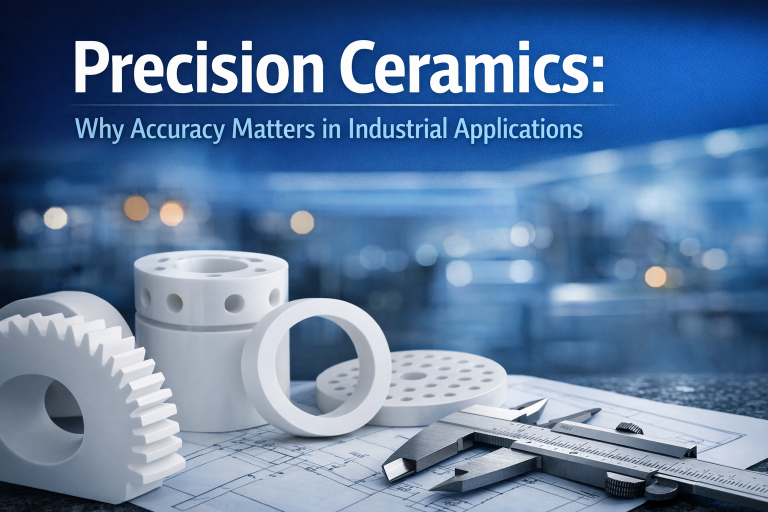
Modern industry relies on materials capable of delivering high performance under increasingly demanding conditions. As systems become more compact, more precise and more exposed to extreme environments, traditional materials such as metals and polymers often reach their limits. In this context, technical ceramics have become essential.
The applications of technical ceramics now extend across a wide range of industrial sectors, including mechanical engineering, electronics, energy, medical technology and micro-precision industries. Their unique combination of durability, stability and functional performance makes them strategic materials for modern industrial systems.
Why Technical Ceramics Are Essential in Modern Industry
Technical ceramics differ fundamentally from traditional ceramics. Engineers design them specifically to meet functional requirements rather than aesthetic ones. Their role is to solve industrial problems linked to wear, heat, corrosion, precision and long-term reliability.
These materials offer exceptional hardness, high temperature resistance and strong chemical stability. Moreover, they maintain their dimensions over time, even under mechanical or thermal stress. As a result, technical ceramics improve system reliability while reducing maintenance and downtime.
This explains why the applications of technical ceramics continue to expand across advanced industries worldwide.
Applications of Technical Ceramics in Industrial and Mechanical Engineering
In mechanical and industrial engineering, technical ceramics increasingly replace metals in parts exposed to continuous wear or friction. Their extreme hardness significantly reduces abrasion and surface degradation.
Common applications include bearings, seals, bushings, guides, nozzles and pump components. These parts often operate in abrasive or corrosive environments where metallic solutions suffer from rapid wear.
Because technical ceramics do not corrode and resist chemical attack, they ensure long service life and stable performance, even in harsh operating conditions.
Applications of Technical Ceramics in Electronics and Electrical Systems
Electronics is one of the fastest-growing fields for technical ceramics. Modern electronic systems require materials that combine electrical insulation with efficient thermal management.
Technical ceramics serve as substrates, insulators and housings for electronic components. They provide excellent dielectric properties while dissipating heat effectively. This dual function is critical for power electronics, sensors and high-density circuits.
As electronic devices become smaller and more powerful, the applications of technical ceramics play a key role in ensuring safety, stability and performance.
Applications in the Energy Sector
The energy sector places extreme demands on materials. High temperatures, thermal cycling and aggressive chemical environments are common. Technical ceramics meet these challenges effectively.
They are widely used in fuel cells, thermal insulation systems, sensors, turbines and energy storage technologies. Their ability to maintain mechanical and chemical stability at high temperatures improves efficiency and operational safety.
In renewable and conventional energy systems alike, technical ceramics contribute to durability, performance and long-term reliability.
Medical Applications of Technical Ceramics
Medical technology represents one of the most critical application areas for technical ceramics. Their biocompatibility, wear resistance and chemical inertness make them ideal for use inside the human body.
Applications include orthopedic implants, dental components, surgical instruments and implantable medical devices. Unlike some metals, technical ceramics do not corrode or release harmful ions. They also reduce the risk of allergic reactions.
In the medical field, the applications of technical ceramics directly improve patient safety, implant longevity and clinical outcomes.
Role in Microtechnology and Precision Industries
Microtechnology and precision engineering require materials capable of maintaining micrometric tolerances over long periods. Technical ceramics excel in this area thanks to their dimensional stability.
They are widely used in watchmaking, micro-mechanisms, positioning systems and miniature components. Even small temperature variations or repeated mechanical cycles do not significantly affect their geometry.
For industries where precision is non-negotiable, technical ceramics provide a reliable and consistent solution.
Why the Applications of Technical Ceramics Keep Expanding
Industrial systems are evolving toward higher performance, longer service life and lower environmental impact. In many cases, conventional materials struggle to meet these expectations.
Technical ceramics help manufacturers reduce wear, limit maintenance and improve overall system efficiency. Although their initial cost may be higher, their long-term economic benefits often outweigh this investment.
As a result, the applications of technical ceramics continue to grow wherever reliability, precision and durability are critical.
Limitations and Design Considerations
Despite their advantages, technical ceramics are not suitable for every application. They are more sensitive to impact than metals and do not deform plastically before failure.
For this reason, engineers must consider load conditions carefully during the design phase. Proper geometry, mounting and load distribution are essential when using ceramic components.
When applied correctly, however, technical ceramics deliver unmatched performance in demanding environments.
Conclusion
The applications of technical ceramics span nearly every sector of modern industry. From mechanical engineering and electronics to energy, medical technology and micro-precision systems, these materials enable performance levels that traditional solutions cannot achieve.
Thanks to their hardness, thermal stability, chemical resistance and dimensional accuracy, technical ceramics have become strategic materials for the industry of today and tomorrow. As industrial requirements continue to rise, their role will only become more important.