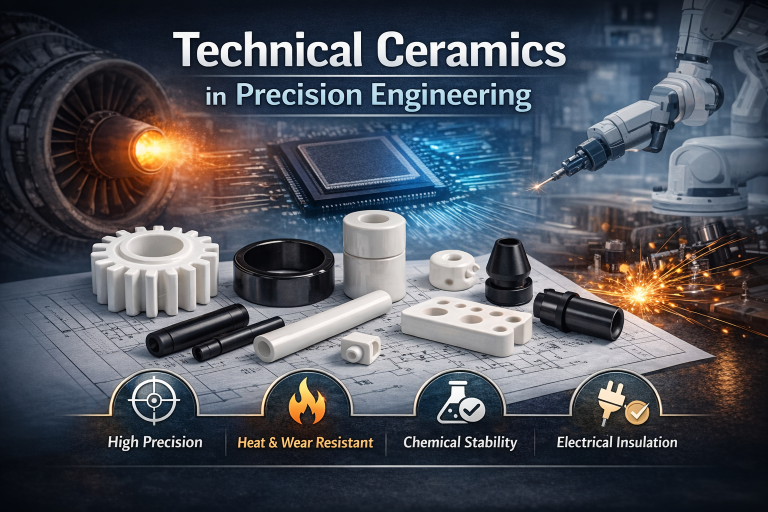
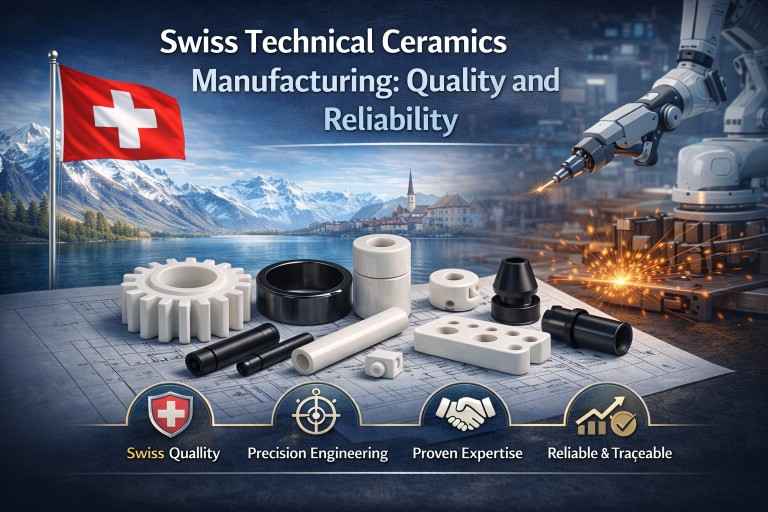
In high-performance industries such as microtechnology, medical devices, watchmaking, aerospace, energy and chemical processing, the choice of a technical ceramics manufacturer is a strategic decision. Component reliability, dimensional accuracy and long-term stability are critical factors that directly impact product performance and safety.
Switzerland has established itself as a global benchmark in precision manufacturing. Choosing a Swiss technical ceramics manufacturer means working with a partner that combines advanced materials science, rigorous quality standards and a long-standing culture of industrial excellence.
A Strong Heritage of Precision Engineering
Swiss industry is internationally recognised for its precision. This reputation, built through watchmaking, micro-mechanics and high-end instrumentation, naturally extends to technical ceramics manufacturing. Swiss manufacturers apply the same attention to detail, process control and repeatability to ceramic components.
As a result, they are capable of producing parts with extremely tight tolerances, stable geometries and consistent mechanical properties. This level of precision is essential in applications where even micrometric deviations can lead to functional failure.
Full Control of the Manufacturing Process
One of the key strengths of Swiss technical ceramics manufacturers is their ability to control the entire production chain. From raw material selection to final inspection, every step is managed in-house or under strict supervision.
This includes powder preparation, shaping, debinding, high-precision sintering, post-sintering machining and final quality control. Such vertical integration ensures full traceability, predictable shrinkage behaviour and consistent microstructures. It also reduces risks associated with excessive subcontracting and process variability.
High Quality Standards and Traceability
Swiss manufacturers operate under some of the most demanding quality frameworks in the world. ISO certifications, documented process control, advanced metrology and full batch traceability are standard practice.
These standards are particularly critical in regulated sectors such as medical technology and aerospace. They ensure reproducibility, compliance with international regulations and long-term reliability. Detailed technical documentation and transparent quality systems strengthen trust between manufacturer and customer.
Expertise in High-Value, Complex Applications
Rather than focusing on mass-produced standard components, Swiss technical ceramics manufacturers specialise in complex, high-value applications. These typically involve demanding operating conditions, intricate geometries or extreme performance requirements.
Examples include components exposed to high temperatures, aggressive chemicals, mechanical wear or cyclic loads. Swiss expertise also extends to aesthetic and functional parts for luxury watchmaking, where precision and surface quality are equally important.
This application-driven approach allows manufacturers to deliver tailored solutions rather than off-the-shelf products.
Continuous Innovation and Advanced R&D
Innovation is a core pillar of the Swiss industrial ecosystem. Technical ceramics manufacturers invest heavily in research and development, often in collaboration with universities, research institutes and technology centres.
Ongoing developments focus on ceramic composites, improved fracture toughness, microstructural optimisation and additive manufacturing. Ceramic 3D printing and advanced sintering techniques are opening new possibilities for complex shapes and functional integration. This innovation capability enables Swiss manufacturers to anticipate future industrial challenges.
Reliability, Responsiveness and Long-Term Partnership
Beyond technical excellence, Swiss manufacturers are known for their operational reliability. Lead times are respected, communication is structured and project management is transparent.
More importantly, they typically adopt a partnership-oriented approach. Customers are supported from the design phase onward, with guidance on material selection, geometry optimisation and manufacturability. This collaboration reduces development risks and improves overall system performance.
A Strong Commitment to Sustainability
Switzerland enforces strict environmental and safety regulations. As a result, technical ceramics manufacturers integrate sustainable practices into their operations. Energy efficiency, waste reduction and responsible material use are increasingly prioritised.
In addition, the long service life of ceramic components contributes to sustainability by reducing maintenance, replacements and resource consumption over time. Durability is therefore both an economic and environmental advantage.
Conclusion
Choosing a Swiss technical ceramics manufacturer means investing in precision, quality and long-term reliability. Swiss expertise combines advanced materials knowledge, strict quality control, continuous innovation and a partnership-driven mindset.
For industries where performance cannot be compromised, Swiss manufacturers offer a strategic advantage. Their ability to deliver durable, high-precision ceramic components makes them trusted partners for the most demanding industrial applications worldwide.
Sources
Scientific and Technical References
- German, R. M. Ceramic Processing and Sintering, Wiley.
- Rahaman, M. N. Ceramic Processing and Sintering, CRC Press.
- Kang, S. J. L. Sintering: Densification, Grain Growth and Microstructure, Elsevier.
- Journal of the European Ceramic Society – research articles on advanced technical ceramics.
Industry and Manufacturer Resources
- CeramTec – Technical Ceramics Manufacturing and Quality Standards.
- Morgan Advanced Materials – Advanced Ceramics Engineering Solutions.
- Saint-Gobain Ceramics – Technical Ceramics Processing and Applications.
- Kyocera Fine Ceramics – Precision Ceramic Manufacturing Technologies.
Standards and Organisations
- ISO 9001 / ISO 13485 – Quality management systems.
- ISO 13356 – Yttria-stabilized zirconia for surgical implants.
- ACerS (American Ceramic Society) – Technical publications on ceramic engineering.
- ASM Handbook, Volume 4 – Ceramics and Glasses.