Choosing the right material is a critical decision in industrial engineering. It directly impacts performance, durability, production cost and long-term reliability. For decades, metals have been the default choice for most industrial components. However, increasing technical constraints and performance expectations are changing this paradigm.
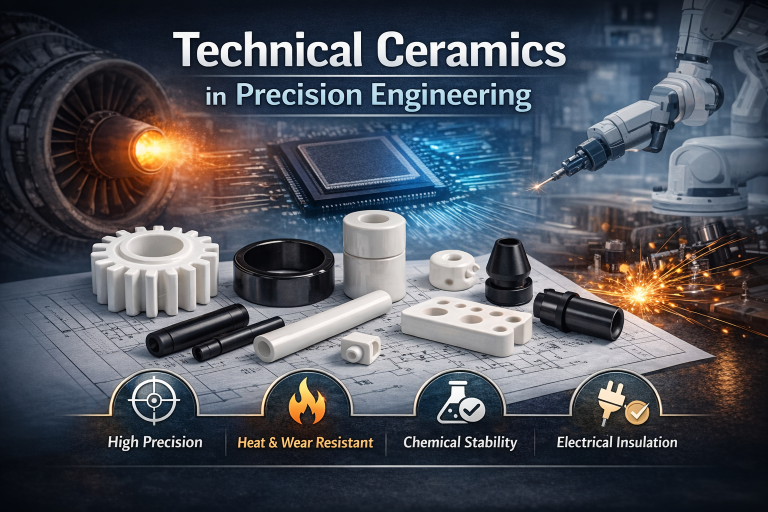
Today, the comparison technical ceramics vs metals has become central in many industries. Technical ceramics are no longer niche materials. They now offer concrete advantages in applications where wear resistance, precision and stability are essential. Understanding the differences between these two material families helps manufacturers select the most suitable solution for each industrial part.
Mechanical Strength: Different Performance Logics
Metals are widely used because of their ductility. They deform before breaking, which allows them to absorb shocks and mechanical overloads. This behaviour makes metals reliable for structural parts exposed to impact or variable loads.
Technical ceramics behave differently. They are extremely hard and rigid, which gives them outstanding resistance to wear, abrasion and surface damage. Instead of deforming, they maintain their shape under load. As a result, they perform exceptionally well in applications involving continuous friction, sliding contact or high surface pressure.
In the technical ceramics vs metals comparison, ceramics dominate in wear-intensive environments, while metals remain advantageous where impact resistance is critical.
Weight and Density: A Structural Advantage for Ceramics
Weight reduction has become a key design objective in many industries. Metals such as steel or copper have relatively high density, which can limit performance in dynamic systems.
Technical ceramics are generally lighter than metals, while maintaining high mechanical strength. This superior strength-to-weight ratio makes them particularly attractive for microtechnology, automation, energy systems and high-speed machinery.
Reducing mass improves efficiency, lowers energy consumption and increases system responsiveness. In this context, technical ceramics provide a clear advantage over metals.
Durability and Wear Resistance
Durability is one of the most decisive criteria when comparing technical ceramics vs metals.
Metals are sensitive to corrosion, oxidation and fatigue. Even with surface treatments or coatings, they degrade over time, especially in aggressive environments. Wear and corrosion often lead to frequent maintenance and part replacement.
Technical ceramics, by contrast, are chemically inert. They do not rust, resist acids and bases, and maintain their properties over long periods. Their exceptional wear resistance significantly extends component lifespan and reduces downtime.
For industrial parts exposed to harsh conditions, ceramics often outperform metals in long-term reliability.
Thermal Behaviour and Dimensional Stability
Temperature variations can strongly affect material performance. Metals expand significantly when heated, which can cause alignment issues, loss of precision or assembly problems.
Technical ceramics offer excellent thermal stability. Many grades retain their mechanical properties at high temperatures and show low thermal expansion. This stability is essential for applications requiring tight tolerances and repeatable performance.
In addition, ceramics can provide thermal or electrical insulation, which metals cannot offer without additional components. This multifunctional behaviour strengthens their position in high-precision industrial systems.
Cost Considerations: Short-Term vs Long-Term Perspective
At first glance, metals are usually less expensive. Their manufacturing processes are well established and optimised for large-scale production.
Technical ceramics involve more complex processes such as precision sintering and diamond machining. Consequently, their initial cost is often higher.
However, when evaluating total cost of ownership, the picture changes. Thanks to longer service life, reduced wear and minimal maintenance, technical ceramics can become more cost-effective over time. In many cases, fewer replacements and lower downtime offset the higher initial investment.
Limitations of Technical Ceramics
Despite their advantages, technical ceramics are not universal solutions.
They are more sensitive to impact than metals. Poor design or sudden shocks can lead to brittle failure. For this reason, engineers must carefully consider load conditions during the design phase.
In addition, ceramic parts require early design optimisation. Post-production adjustments are limited and expensive. Selecting ceramics therefore demands close collaboration between designers and manufacturers.
For applications that do not require high wear resistance or thermal stability, metals may remain the simpler and more economical choice.
When to Choose Technical Ceramics Instead of Metals
Technical ceramics become the preferred option when industrial parts face:
- continuous wear or friction
- corrosive or chemically aggressive environments
- high operating temperatures
- strict dimensional stability requirements
- weight reduction constraints
Metals remain more suitable for components subjected to heavy impact, large deformations or highly variable mechanical loads.
Conclusion
The comparison technical ceramics vs metals highlights two fundamentally different material philosophies. Metals offer toughness, versatility and impact resistance. Technical ceramics deliver precision, durability and exceptional wear performance.
The optimal choice always depends on the application. In many modern industrial systems, technical ceramics complement or replace metals to achieve higher efficiency, longer lifespan and improved reliability. As industrial requirements continue to evolve, technical ceramics are becoming a strategic material choice rather than a niche alternative.