
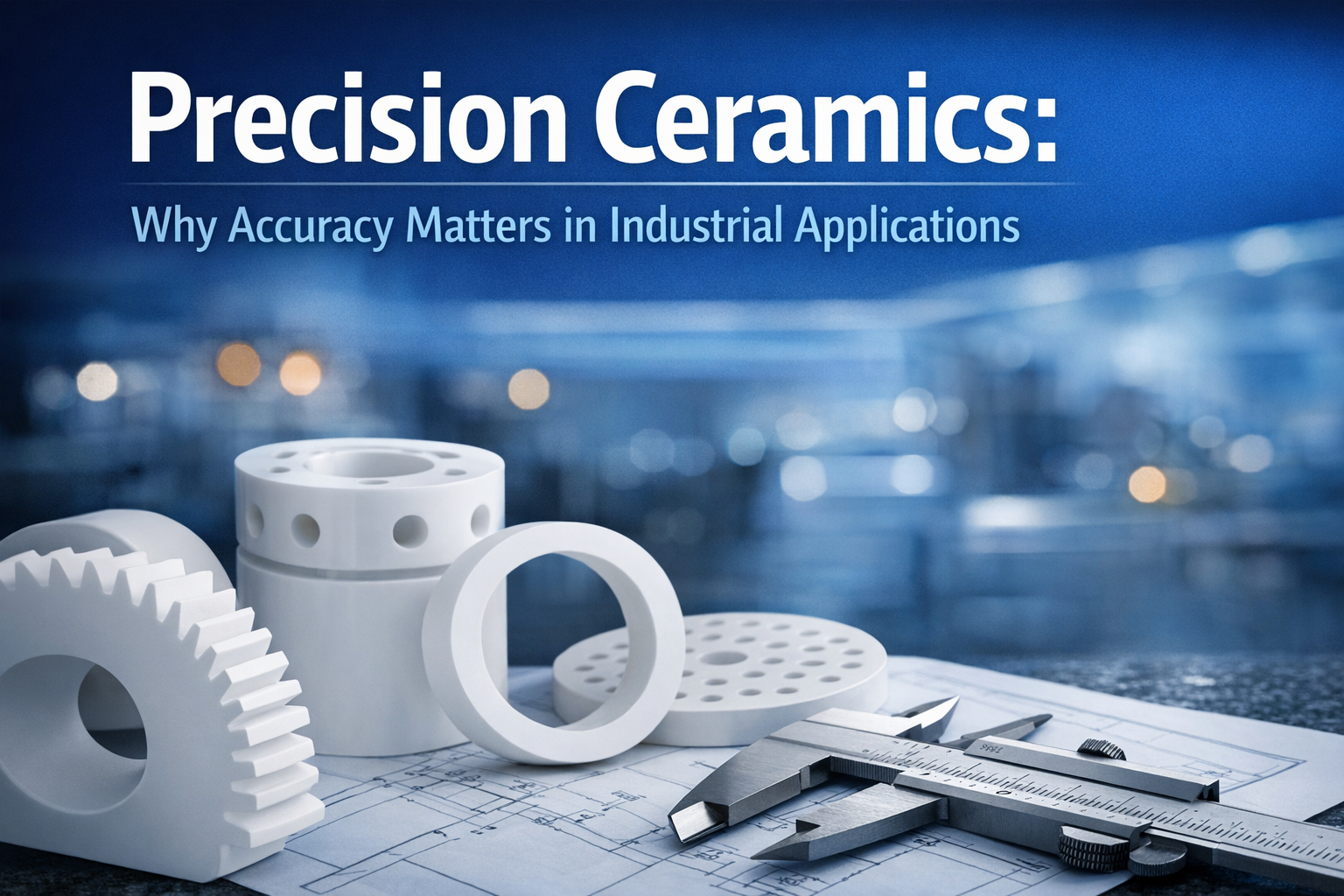
In high-performance industries, where tolerances are measured in microns and failure is not an option, precision ceramics have become essential materials. Known for their exceptional hardness, thermal stability, and resistance to wear and corrosion, these advanced ceramics are widely used in sectors such as aerospace, medical devices, electronics, and energy.
However, beyond material properties, precision manufacturing plays a critical role. Even the most advanced ceramic will underperform if it is not engineered with exacting accuracy. This article explains why precision ceramics matter, how they are manufactured, and where they deliver the greatest value in industrial applications.
1. What Are Precision Ceramics?
Precision ceramics refer to technical ceramic components manufactured with extremely tight tolerances, often down to a few microns. These materials include:
- Alumina (Al₂O₃)
- Zirconia (ZrO₂)
- Silicon carbide (SiC)
- Silicon nitride (Si₃N₄)
Unlike traditional ceramics, these materials are engineered for mechanical, thermal, and chemical performance, not aesthetics. What makes them “precision” is not only the material itself, but the high level of control during shaping, sintering, and finishing processes.
2. Why Precision Matters in Industrial Applications
2.1 Tight Tolerances and Performance
In industries like aerospace or semiconductors, even a deviation of a few microns can lead to:
- Mechanical failure
- Reduced efficiency
- Increased wear
Precision ceramics ensure perfect dimensional stability, allowing components to fit and function exactly as intended.
2.2 Reliability in Extreme Conditions
Precision ceramic components are often used in environments involving:
- High temperatures
- Aggressive chemicals
- High friction or pressure
Accuracy in manufacturing ensures uniform material behavior, reducing the risk of cracks, deformation, or premature failure.
2.3 Improved Lifespan and Cost Efficiency
Although precision ceramics can be more expensive upfront, they offer:
- Longer service life
- Reduced maintenance
- Fewer replacements
This leads to lower total cost of ownership, especially in demanding industrial systems.
3. Key Manufacturing Processes Behind Precision Ceramics
Achieving high precision requires a combination of advanced processes:
3.1 Powder Preparation
The process starts with high-purity ceramic powders, ensuring consistent material properties.
3.2 Shaping Techniques
Common shaping methods include:
- Dry pressing
- Isostatic pressing
- Injection molding
These methods allow near-net-shape production before final machining.
3.3 Sintering
The shaped parts are heated at high temperatures to:
- Increase density
- Enhance mechanical strength
Sintering must be precisely controlled to avoid distortion.
3.4 Precision Machining
After sintering, components are often machined using:
- Diamond grinding
- Laser machining
- CNC finishing
This step is critical to achieve tight tolerances and surface finishes required for industrial use.
4. Applications of Precision Ceramics
Precision ceramics are used across multiple high-tech industries:
4.1 Aerospace
- Thermal shields
- Engine components
- Insulation parts
Their ability to withstand extreme temperatures makes them indispensable.
4.2 Medical Industry
- Dental implants
- Surgical instruments
- Biocompatible components
Zirconia, for example, is widely used for its strength and biocompatibility.
4.3 Electronics and Semiconductors
- Substrates
- Insulators
- Wafer handling components
Precision ceramics ensure electrical insulation and dimensional accuracy.
4.4 Industrial Machinery
- Bearings
- Seals
- Wear-resistant parts
They reduce friction and extend equipment lifespan.
5. Advantages of Precision Ceramics
Precision ceramics offer a unique combination of properties:
- Exceptional hardness
- High wear resistance
- Thermal stability
- Electrical insulation
- Chemical resistance
When combined with precise manufacturing, these advantages translate into high-performance, reliable components.
6. Challenges and Considerations
Despite their benefits, precision ceramics also present challenges:
- Complex machining processes
- Higher initial cost
- Fragility under tensile stress
This is why expert manufacturing and design optimization are crucial to fully leverage their potential.
Conclusion
Precision ceramics are more than just advanced materials, they are critical components for modern industrial performance. Their success depends not only on their intrinsic properties but also on the accuracy of their manufacturing processes.
In industries where reliability, durability, and performance are non-negotiable, investing in precision ceramics ensures long-term efficiency and operational excellence.


