
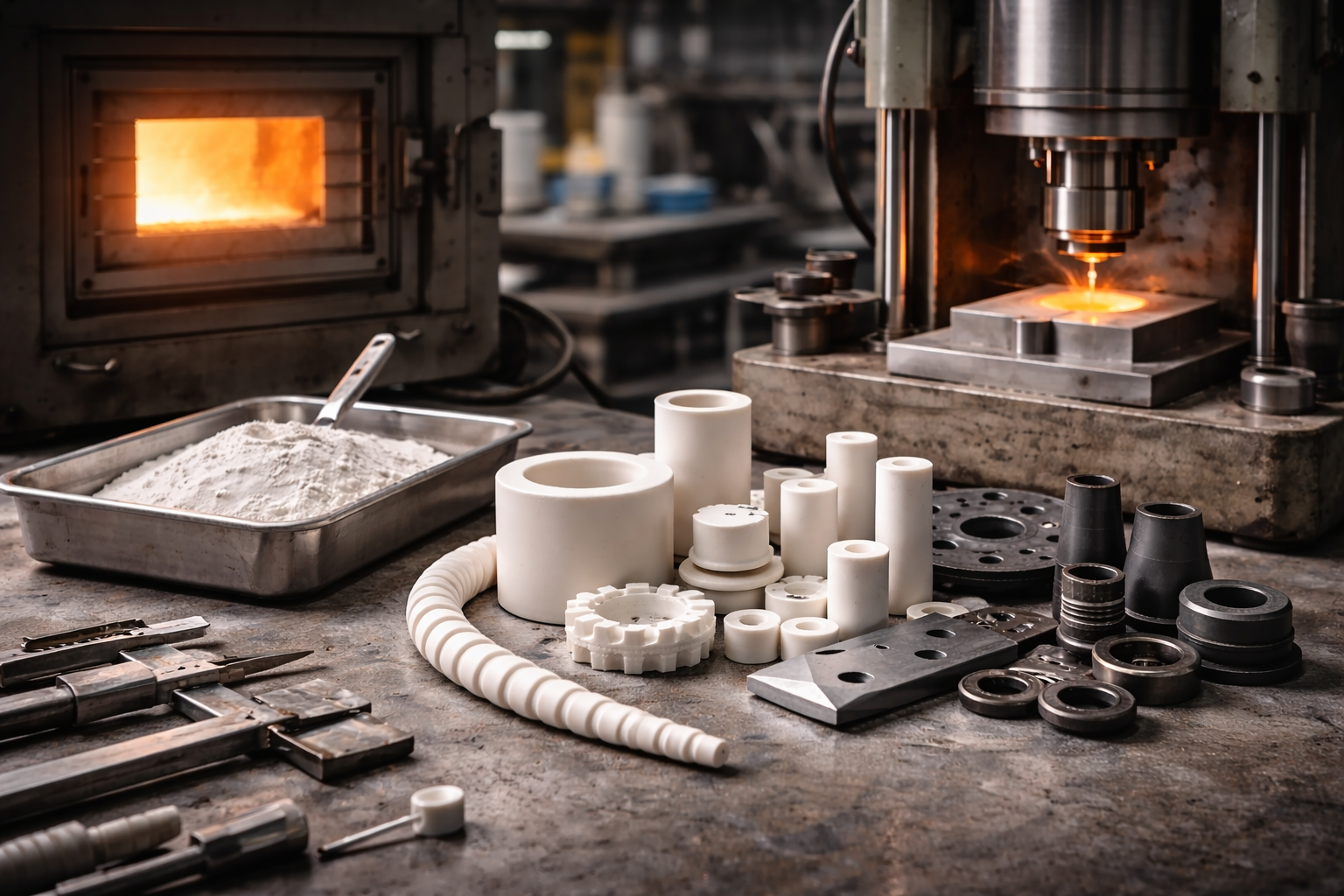
Technical ceramics are widely used in industries that require high durability, precision and resistance to extreme environments. Components made from advanced ceramics can withstand high temperatures, mechanical stress, corrosion and abrasion better than many conventional materials.
However, these exceptional properties are not obtained by chance. They result from a carefully controlled industrial process. Technical ceramic manufacturing involves several key stages that transform fine ceramic powders into dense, high-performance components.
Understanding this manufacturing process helps engineers and decision-makers appreciate why technical ceramics offer such reliable performance in demanding applications.
1. Raw Material Preparation
The first step in technical ceramic manufacturing begins with the preparation of high-purity ceramic powders.
Unlike traditional ceramics, advanced ceramics use refined materials such as:
- alumina (Al₂O₃)
- zirconia (ZrO₂)
- silicon carbide (SiC)
- silicon nitride (Si₃N₄)
These powders are carefully processed to achieve consistent particle size and purity. Manufacturers often mix them with binders, dispersants and additives that improve shaping and processing.
This stage is crucial because the quality of the powder directly affects the performance of the final ceramic component.
2. Shaping the Ceramic Component
Once the powder mixture is prepared, the next step is shaping the part. At this stage, the ceramic still exists as a compacted powder structure often called a green body.
Several forming methods are used in technical ceramic manufacturing, including:
- dry pressing
- isostatic pressing
- ceramic injection molding
- slip casting
Each technique is chosen according to the geometry, size and production volume of the component.
The resulting green part already resembles the final product, but it remains fragile and porous.
3. Drying and Stabilization
After shaping, the ceramic component must be stabilized through a controlled drying process.
This stage removes moisture and solvents introduced during forming. Proper drying is essential because uneven evaporation can cause cracks, deformation or internal stresses.
Manufacturers therefore control temperature and humidity carefully to ensure the part maintains its intended geometry before the next stage.
4. Sintering: The Key Step in Ceramic Manufacturing
The most critical stage in technical ceramic manufacturing is sintering.
During sintering, the ceramic component is heated in a furnace at extremely high temperatures, often between 1,200°C and 2,000°C, depending on the material.
At these temperatures, the ceramic particles bond together and the structure becomes dense and strong. The component develops its final mechanical, thermal and chemical properties.
During this process, the part usually shrinks as the material densifies. Engineers must therefore account for this dimensional change during the design phase.
5. Precision Machining and Finishing
After sintering, some ceramic parts require additional finishing operations to meet strict dimensional tolerances.
Because ceramics are extremely hard, machining typically involves diamond tools or grinding processes.
These finishing operations allow manufacturers to achieve:
- precise dimensions
- smooth surface finishes
- complex geometries
- micrometric tolerances
This level of precision is particularly important in industries such as microtechnology, electronics and advanced mechanical systems.
6. Quality Control and Testing
The final stage in technical ceramic manufacturing involves rigorous quality control.
Manufacturers inspect ceramic components to verify:
- dimensional accuracy
- density and microstructure
- mechanical strength
- absence of internal defects
Advanced inspection methods such as microscopy, ultrasonic testing or X-ray analysis may be used to ensure consistent quality.
These checks guarantee that each component meets the performance requirements of demanding industrial applications.
Why Technical Ceramic Manufacturing Requires Specialized Expertise
The production of advanced ceramics requires precise control at every stage. Small variations in powder composition, shaping conditions or sintering temperature can significantly affect the final properties of the material.
For this reason, technical ceramic manufacturing demands specialized equipment, deep materials knowledge and strict process control.
When performed correctly, this manufacturing process produces components capable of operating in environments where metals or polymers fail.
Conclusion
Technical ceramic manufacturing transforms high-purity powders into durable, high-performance industrial components. Through stages such as powder preparation, shaping, sintering and precision finishing, manufacturers create parts that withstand heat, wear and aggressive environments.
Thanks to this controlled process, technical ceramics have become essential materials in modern industry. Their ability to deliver reliability, stability and long service life makes them ideal for advanced engineering applications.


