
Introduction
Ceramic molding is one of the most effective manufacturing methods for producing high-performance technical components used in demanding industrial environments. As industries push toward greater precision, durability, and efficiency, traditional materials and machining methods often reach their limits.
This is where ceramic molding stands out. By enabling the production of complex geometries while preserving the exceptional properties of advanced ceramics, this process has become a strategic solution for sectors such as aerospace, medical technology, electronics, and precision engineering.
Understanding how ceramic molding works—and why it is so widely adopted—provides valuable insight into its growing role in modern industrial manufacturing.
1. What is ceramic molding?
Ceramic molding refers to a group of manufacturing processes in which ceramic powders or suspensions are shaped into a desired form using a mold, before being consolidated through high-temperature sintering.
Unlike traditional machining, where material is removed from a solid block, ceramic molding allows manufacturers to create parts that are already close to their final shape. This significantly reduces material waste, minimizes machining operations, and improves production efficiency.
This approach is particularly important when working with advanced ceramics such as alumina, zirconia, silicon carbide, or silicon nitride. These materials are extremely hard and difficult to machine, making molding the most efficient way to fully exploit their properties.
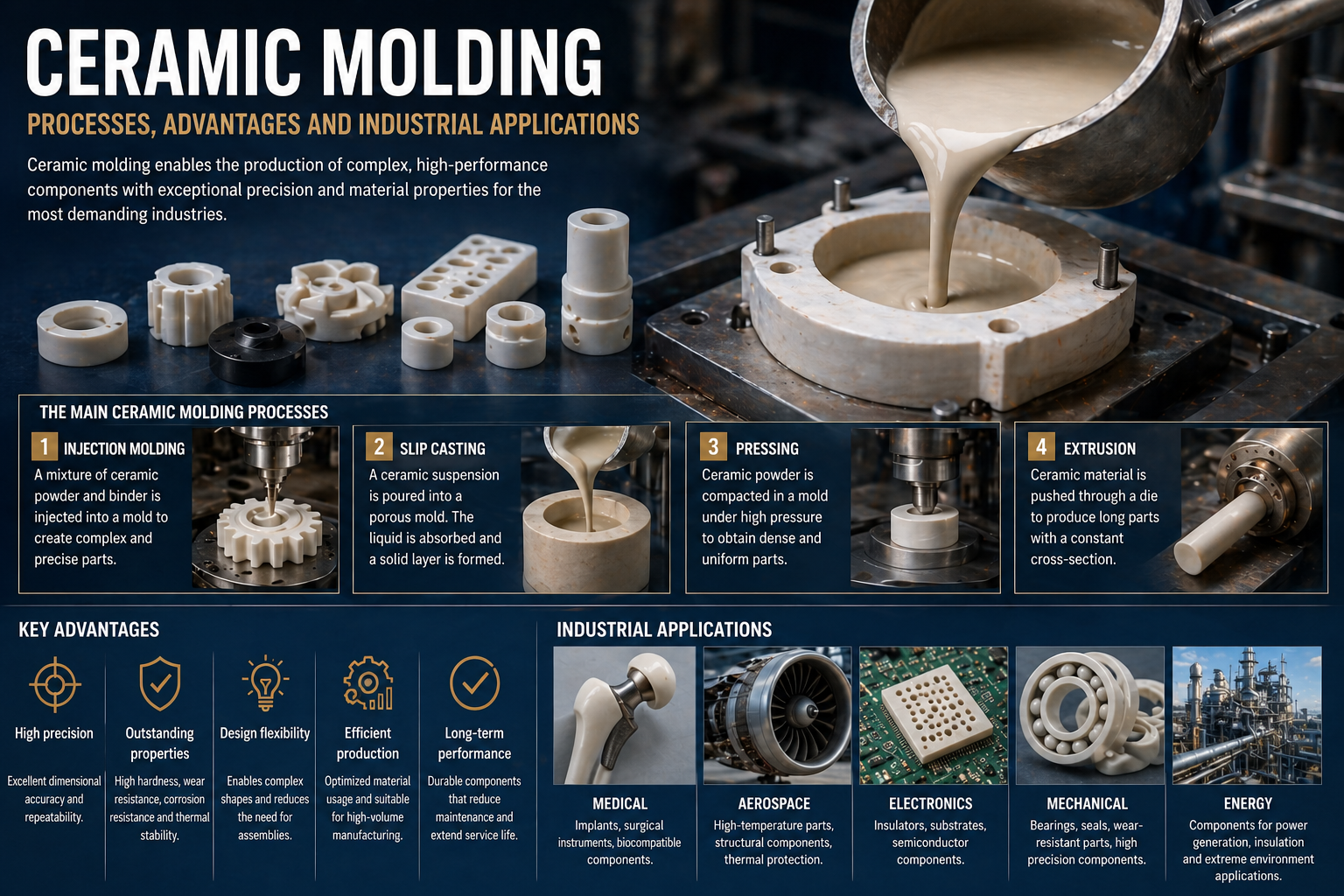
2. Main ceramic molding processes
There is no single ceramic molding technique. Instead, several processes are used depending on the complexity of the part, the required precision, and production volume.
Injection molding, often referred to as CIM (Ceramic Injection Molding), is widely used for small, highly precise components. In this process, a mixture of ceramic powder and binder is injected into a mold, allowing for the production of intricate shapes with excellent repeatability. It is particularly suited for high-volume manufacturing.
Slip casting is another important method, based on a liquid ceramic suspension poured into a porous mold. The mold absorbs the liquid phase, leaving a solid ceramic layer behind. This technique is ideal for hollow parts or complex geometries that would be difficult to achieve with other methods.
Pressing, whether uniaxial or isostatic, involves compacting ceramic powder under pressure to form dense and uniform parts. It offers good dimensional accuracy and is commonly used for simpler shapes where high mechanical strength is required.
Extrusion is used for producing components with a constant cross-section, such as tubes or rods. It is particularly effective for continuous production and industrial-scale manufacturing.
Each of these processes serves a specific purpose, and selecting the right one is essential to achieving optimal performance.
3. Why ceramic molding is so effective
The effectiveness of ceramic molding lies in its ability to combine design flexibility with high-performance material properties.
Because parts are shaped before sintering, engineers can design components that are optimized for their function rather than constrained by machining limitations. This reduces the need for assembly, improves structural integrity, and enhances overall system performance.
In addition, molded ceramic parts retain the inherent advantages of technical ceramics. They can withstand extremely high temperatures, resist wear and corrosion, and maintain excellent dimensional stability even in harsh environments.
This combination of properties makes ceramic molding particularly valuable in applications where reliability and longevity are critical.
4. Industrial applications of ceramic molding
Ceramic molding is used across a wide range of industries where performance and precision are essential.
In the medical field, it enables the production of biocompatible components such as implants and surgical tools. The ability to achieve precise geometries and smooth surfaces is crucial in these applications.
In aerospace and energy industries, molded ceramic components are used in high-temperature environments, where metals would fail due to oxidation or deformation. Their thermal resistance and stability make them ideal for such conditions.
In electronics and semiconductor manufacturing, ceramic molding is used to produce insulating components and substrates. These parts must meet strict requirements in terms of electrical performance and dimensional accuracy.
In mechanical engineering, ceramic components are often used to reduce wear, improve efficiency, and extend the lifespan of machinery. Bearings, seals, and wear-resistant parts benefit significantly from the properties of molded ceramics.
5. Limitations and considerations
Despite its many advantages, ceramic molding requires careful control throughout the manufacturing process. Drying and sintering stages must be precisely managed to avoid defects such as cracking or deformation.
Additionally, ceramics are inherently brittle materials. This means that part design must account for mechanical stresses to prevent failure during use.
Finally, the initial cost of tooling and process setup can be higher compared to traditional manufacturing methods. However, these costs are typically offset by improved durability, reduced maintenance, and long-term performance gains.
Conclusion
Ceramic molding is a highly efficient and versatile manufacturing process that enables the production of complex, high-performance components for industrial applications. By combining advanced materials with optimized shaping techniques, it offers a unique balance of precision, durability, and cost efficiency.
As industrial requirements continue to evolve, ceramic molding is becoming an increasingly strategic solution for companies seeking reliable and long-lasting components. Mastering this process is not only a technical advantage—it is a key driver of competitiveness in modern manufacturing.


