Introduction
In modern manufacturing, precision is no longer a competitive advantage, it is a requirement. Industries such as aerospace, medical devices, electronics, and advanced machinery rely on components that must operate with extreme accuracy and reliability.
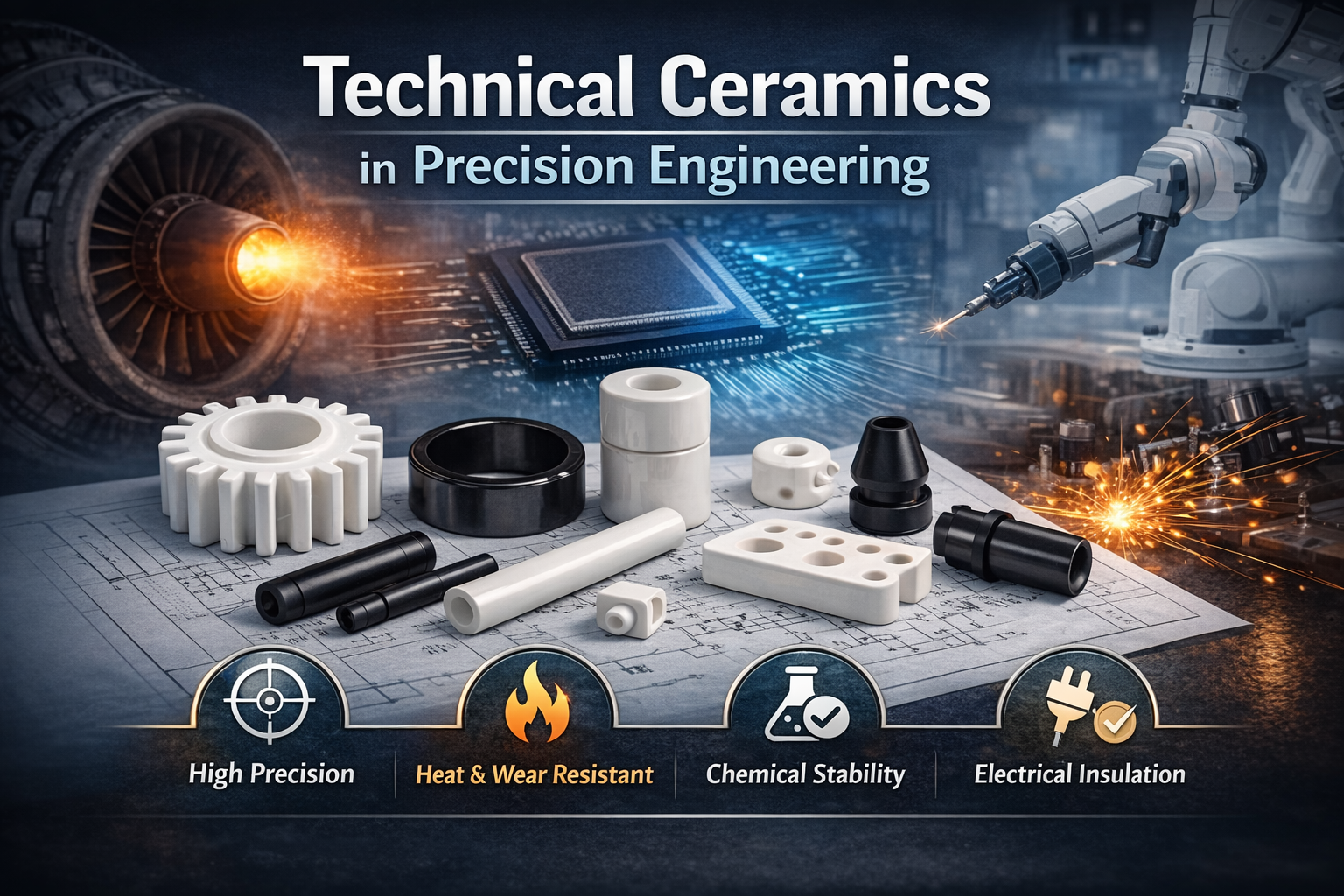
This is where precision engineering ceramics play a critical role. Thanks to their exceptional mechanical, thermal, and chemical properties, technical ceramics have become indispensable materials in high-precision applications.
This article explores how precision engineering ceramics are used, why they are essential, and what makes them superior to traditional materials.
1. What Are Precision Engineering Ceramics?
Precision engineering ceramics refer to advanced ceramic materials specifically designed and manufactured for high-accuracy industrial applications.
Unlike conventional ceramics, these materials are engineered for performance and include:
- Alumina (Al₂O₃)
- Zirconia (ZrO₂)
- Silicon carbide (SiC)
- Silicon nitride (Si₃N₄)
They are processed using advanced manufacturing techniques to achieve tight tolerances, high density, and superior surface finishes.
2. Why Technical Ceramics Are Essential in Precision Engineering
2.1 Dimensional Stability and Accuracy
In precision engineering, even microscopic deviations can lead to system failure.
Precision engineering ceramics offer:
- Low thermal expansion
- High dimensional stability
- Excellent tolerance control
This ensures consistent performance, even in demanding environments.
2.2 Resistance to Extreme Conditions
Technical ceramics can withstand:
- High temperatures
- Corrosive environments
- Mechanical stress
Unlike metals, they do not deform or oxidize easily, making them ideal for critical applications.
2.3 Superior Wear Resistance
Ceramics are significantly harder than most metals, which allows them to:
- Resist abrasion
- Reduce friction
- Maintain surface integrity over time
This is particularly important for moving components and high-friction systems.
2.4 Electrical and Thermal Insulation
Many precision engineering ceramics provide excellent:
- Electrical insulation
- Thermal resistance
This makes them essential for electronic systems and semiconductor manufacturing.
3. Manufacturing Process of Precision Ceramic Components
Producing high-quality ceramic components requires advanced processes:
3.1 Powder Preparation
High-purity powders are used to ensure uniformity and performance.
3.2 Forming Techniques
Common shaping methods include:
- Dry pressing
- Isostatic pressing
- Injection molding
3.3 Sintering
Parts are fired at high temperatures to achieve:
- High density
- Mechanical strength
3.4 Precision Machining
Final finishing involves:
- Diamond grinding
- CNC machining
- Laser processing
This step ensures tight tolerances and high surface quality.
4. Applications in Precision Engineering
4.1 Aerospace Industry
- Heat-resistant components
- Engine parts
- Structural elements
4.2 Semiconductor and Electronics
- Substrates
- Insulators
- Wafer handling components
4.3 Medical Technology
- Implants
- Surgical tools
- Biocompatible components
4.4 Industrial Machinery
- Bearings
- Seals
- Wear-resistant parts
5. Advantages of Precision Engineering Ceramics
Using precision engineering ceramics offers several key benefits:
- Exceptional hardness
- Long lifespan
- High temperature resistance
- Chemical stability
- Reduced maintenance
These advantages translate into improved performance and cost efficiency over time.
6. Challenges and Considerations
Despite their benefits, technical ceramics require careful handling:
- Brittle behavior under impact
- Complex manufacturing processes
- Higher initial investment
Working with experienced manufacturers ensures optimal design and performance.
Conclusion
Precision engineering ceramics are essential materials for industries that demand accuracy, durability, and reliability. Their unique combination of properties makes them the ideal choice for high-performance applications.
As industrial requirements continue to evolve, technical ceramics will play an increasingly important role in shaping the future of precision engineering.